Friday, August 25, 2006

Mixing Samurais with Machine Guns


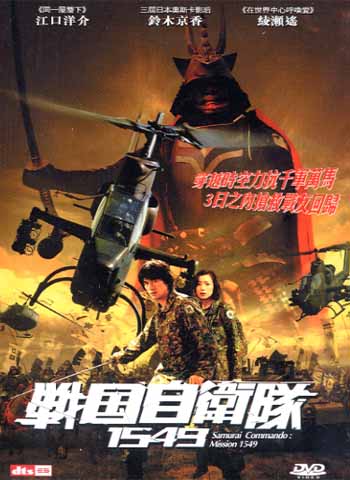
Ever played role playing games? Growing up in the 80's, I was exposed to Dungeons and Dragons, Traveller, etc., and while I seldom played - I always enjoyed making the characters rather than playing the game - my friends did, and after playing the same sword and sorcery scenario for the millionth time, someone got the bright idea of spicing things up by introducing modern day soldiers and throwing them into Middle Earth. There was a lot of fun with that, and that concept is used in this movie, Time Slip 1549, which came out in Japan last year. It is about modern day soldiers, who in a secret government experiment, are somehow thrown back almost 450 years into the past, into the feudal battles between warlords. The first platoon was lost in the first experiment; two years later the government tries again. They know that they were sent into the past, because, after the area they were in disappears, then reappears, so does a lone samurai. They recruit a man who used to be a part of the original platoon, and along with the woman who was in charge of the first experiment, and another platoon, are sent back into the past. There they encounter machine gun toting samurais dressed in camoflauge armor, the lone helicopter from the first group wipes out the new platoons' air support, and a lot of people are killed before they are captured and brought to a castle near Mt Fuji, which is a combination of a classic feudal warlord castle and an oil refinery. Yes, the leader of the first platoon, realizing that there was no way to get back home, decides to become ruler of this universe, easily overcoming the local warlords and accumulating a fighting force of great magnitude. Complete with tanks. This two hour epic was made in honor of the 60th anniversary of Kadokawa Pictures. The movie, related to but not a remake of G.I. Samurai, starring Sonny Chiba, is a fun action movie, not to be taken too seriously. Otherwise the warts and seams will show, and yes, the ending drags on for about 10 minutes too long, as they feel the need to push all the emotional buttons. One subcontext that I found interesting was here we have the modern Japanese military, reformed in organization and in spirit after World War II, tossed back into time where everybody was at war with each other. And the modern soldiers gets their asses kicked! So for them to survive, the original platoon guys rediscover their old fighting spirit, the way of the samurai, as do the second group, but in a slightly different (and of course, a more positive) way. Worth a rental!

Thursday, August 24, 2006

The Bad Really Do Sleep Well

This Criterion dvd, which was released earlier this year in January, is not only one of the great Akira Kurosawa films but one of the greatest crime films ever made. It was made in 1960, a year before Yojimbo (1961), and for some reason it gets overlooked when you read surveys or reviews of Kurosawa's work. Probably because High and Low (1962), his definitive crime movie, was released both on video and dvd before this film, thus getting more exposure? Or is it because it is more complex and longer (2 1/2 hours)? It does feel staged like a play, and it has been said that William Shakespeare's Hamlet was an influence on the story. It is about a young executive (played by Toshiro Mifune) who plots to bring down a group of company higher-ups, because they caused his father's murder. The opening scene is classic, one of the great suspenseful sequences in cinema -- it opens to a wedding reception, and we are introduced to the characters from the point of view of a group of reporters who are covering the event. It is though their eyes that we are drawn into the story, becoming more and more curious as events unfold. The wedding cake is brought out, with various objects that allude to the father's murder. The reporters know they have a story, the perpetrators are aware that someone knows, and our movie begins. Mifune uses a company man (who was stopped from committing suicide) to haunt the killers, going so far as to chalk his face to appear like a ghost. The Mifune character is also involved with the main company man's daughter, who also has a brother who is threatening to kill him if he makes his sister unhappy. Layers upon layers. The ending is not so upbeat, Mifune is killed in an old WWII bunker or underground dwelling, but the villain loses the respect and love of his son and daughter; they ostracize him. When I saw this, I could not help seeing this as a samurai film dressed in contemporary clothes, and reading the notes, this point is view is mentioned. The staging and unfolding of the plot and the characters all are reminiscent of Kurosawa's period piece films, or even other films, like Harakiri. The revenge elements, the scheming and plotting of one man against a larger and more powerful group of men, the dehumanizing effects that power and money can have, are not restricted to any one time period. A classic and one of my all time favorites.

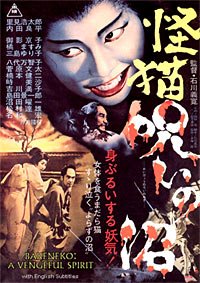
Bakeneko: A Vengeful Spirit

Bakeneko is an interesting film, yet another ghost story movie from the later 60's, but not as powerful or compelling as Kuroneko, or Kwaidan. Briefly, it is about a man, Nabeshima Naoshige, who murders his lord, Takafusa Ryuzoji, for power and his wife. Ryuzoji's wife drowns herself along with her cat in a nearby marsh to avoid Naoshige's clutches. This sets the stage for a decade later, as Naoshige has become a powerful and evil lord, who becomes enamored with a village woman. His attempts to steal and control her causes a curse to befall on him, when she kills herself at the same marsh as Ryuzoji's wife. Thus his downfall begins......... I don't find it as compelling partly because of the execution of the story, decent as it is. Maybe it is the direction, which is workmanlike but not spectacular. I don't get the same sense of creepiness or foreboding as in Kuroneko. Perhaps also, the Naoshige character is too evil, and not as interesting a character, so certainly I want to see his demise, but I didn't care one way or another. Everything moves from a to b to c in a straightforward but bland manner. It is a black and white film, letterboxed with english subtitles, and there are moments of good cinematography, but maybe that was because the director wasn't looking. As I said, an interesting movie recommended to the diehard film lover.

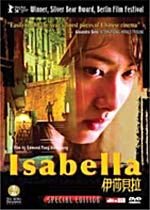
Isabella - a 2006 HK masterpiece?

Nominated for the 2006 Golden Bear, this is a terrific movie about a policeman who is suspended pending hearings of corruption, and his relationship with a young woman who claims to be his daughter. The background is 1999 Macao, which was about to be turned over to China. While there is a definite Wong Kar Wai feel to the film, in terms of impromptu character acting and dialogue, and the slow but deliberate pace, it is very different. For one thing, there is a lot of deception, not only by the characters, but by the director as well. Ho-Cheung Pang sets up a lot of scenes that are meant to be interpreted one way, then later in the film through flashbacks or dialogue turns out to be something else. For instance, it appears that the policeman Shing(Chapman To, in his finest performance to date), after binge drinking and womanizing at a local club, brings home a woman for sex. The following morning, he wakes up and is told by the woman that she is his daughter Isabella (played by Isabella Leong, in her movie debut). Turns out she was outside while another woman was doing all the work, then slipped in after that woman had left. The movie develops into a very well developed study of their relationship, thought the lines of father and daughter are not made clear. Isabella becomes his girlfriend, not to his face, but in dealing with the other women in his life, meeting each one and cutting them off by saying she's his girl. A potential boyfriend for Isabella is thwarted the same way. Shing, on the other hand, reflects on his failed opportunity to take responsibility when, in a flashback, he goes to the clinic with Isabella's mother who is pregnant. She goes in, he is supposed to wait, but he gets cold feet and leaves. Over the course of the movie he begins to take responsibility, especially for the consequence of his actions as a policeman, and be a father. However, Isabella is not whom she seems to be, knowingly or not. A fine drama, some great performances and good directing. It's great to see that Hong Kong cinema can still deliver top quality films, as opposed to the big budget period pieces or crime dramas that have been mined to death recently.

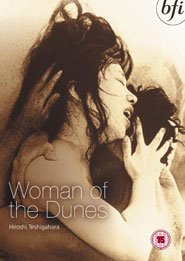
Woman of the Dunes revised

I have seen bootlegs of the "extended" version for sale on ebay, but I am glad I held off from buying. The British Film Institute has recently issued the 141 minute letterboxed version of this fine 1964 Japanese film directed by Hiroshi Teshigahara. This supplants the 123 minute widescreen version that was on Image Entertainment, now out of print. This movie won the Special Jury prize at the 1964 Cannes Film Festival, and was nominated for a couple of Academy Awards, so when it was released, it was recognized as a great film. The movie is about a teacher who while out on a trip, misses the last bus home, and is offered shelter by the local villagers. It so happens they live in a valley where the only access to it is by climbing down a rope ladder. He spends the night at a woman's house, and the following morning discovers that the rope ladder is gone and there is no way out. Plus, the valley is more like a sand pit, where the woman's house is under constant danger of being run over. He ends up helping the woman remove the sand, but it keeps on coming, no matter how much they remove during the day. The hopelessness of their situation draws them closer and they become lovers, though the teacher becomes obsessed with escaping this pit. The movie is gorgeous - black and white, full of minimal and abstract images of the shapeshifting land, closeups of the lovers deep in passion, the darkness and feeling that they are below the earth. Music was done by Toru Takemitsu, a celebrated film composer, who accentuated this otherworldliness. BFI dvds are of high quality, like Criterion, and this is a must buy. I will report on what has been added, as I have the Image dvd.

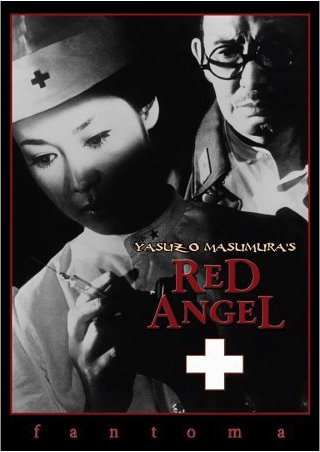
Masumura's Red Angel

"My goal is to create an exaggerated depiction featuring only the ideas and passions of living human beings....In Japanese society, which is essentially regimented, freedom and the individual do not exist. The theme of the Japanese film is the emotions of the Japanese people, who have no choice but to live according to the norms of that society. The cinema has had no alternative but to continue to depict the attitudes and inner struggles of the people who are faced with and oppressed by complex social relationships and the defeat of human freedom....[But] after experiencing Europe for two years, I wanted to portray the type of beautifully vital, strong people I came to know there, even if, in Japan, this would be nothing more than an idea."
- Masumora from a 1958 essay

Although the subject of several film fests, Masumora's films have not been available in the US until fantoma reissued four dvds around 2001 of his work: Afraid to Die, Blind Beast, Manji, and Giants & Toys. In mid-September, they will reissue Red Angel, a mid-60's work about a nurse who is working on the front lines of war. Her relationships with a soldier amputee and a drug addicted surgeon test her spirit, her sense of mission as a nurse, and her will to survive a horrible environment. He slightly predated the "New Wave" of Japanese films of the 60's, led by Oshima, but his movies are unique for their time, depicting gangsters (Afraid to Die), forbidden love triangle between two women and a man (Manji), ruthless business practices of corporations, and their dehumanizing means to make a buck (Giants & Toys), and the relationship between artist and model (Blind Beast). His films all contain clean, vivid photography, developing toward surreal in the later 60's (as seen in his horror masterpiece, Blind Beast, with the artist's studio made into a huge sculpture of human body parts). Japanese movies regarding modern war are ususally engaging, often harrowing (see The Human Condition trilogy, about Japan's occupation of Manchuria), so I will look forward to this release when it comes out.

Two Japanese ghost movies


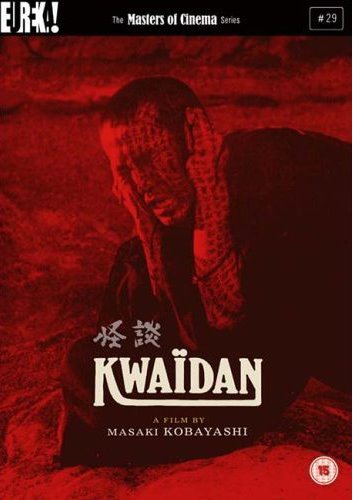
These two dvd releases are good reasons to own an all- region player. The EUREKA! label, based in the UK, has been steadily releasing a series of outstanding movies from around the world at the highest quality. They are very much like the US based Criterion, and some of the releases has overlapped, as in the case of Kwaidan. However, you should pick up the EUREKA version of Kwaidan, because this is the definitive, 183 minute version. 21 minutes of more footage added, never seen before to Western audiences. It comes with a very nice 72 page booklet that includes Lefcadio Hearn's 4 stories, and an interview of the director, Masaki Kobayashi. Kobayashi was a director who exploded onto the world cinema scene in the late 1950's with his epic 9 hour trilogy, The Human Condition, featuring Nadakai Tatsuya, and with the classic Harakiri, one of the great samurai films, in 1962. Kwaidan is THE classic ghost story film, four stories dealing with people who become entangled with the supernatural. The segment Hoichi, the Earless, is my favorite. Hoichi is a blind musician/priest who is called upon to perform before a lord and his entourage. What he doesn't know is that they are all ghosts, and that they will kill him after several perfomances........

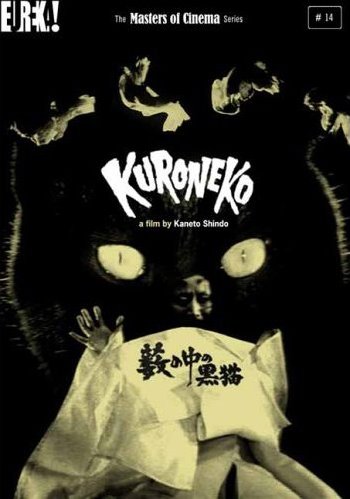
Kuroneko is a major find, and the movie that led me to discover the EUREKA label. This is another classic Japanese ghost story movie, directed by Kaneto Shindo, in 1968. Shindo also directed Onibaba (1964), itself a classic in world cinema. This concerns a mother and daughter who are brutally raped and murdered by a band of roving soldiers during a war; the house is burned down, and in the smouldering ash ruins, a lone cat appears and licks the remains of the women. They are transformed into avenging spirits, changing into human and cat form, who terrorize the woods by killing every solder who travels through. Black and white, sparse, but well paced (the scenes showing the baiting, seduction, then murdering of the soldiers are repeated, but reduced in time in each instance, respecting the viewer's knwoledge of how things will turn out), terrific performances by everyone involved, this is mandatory viewing for any cinema fan.